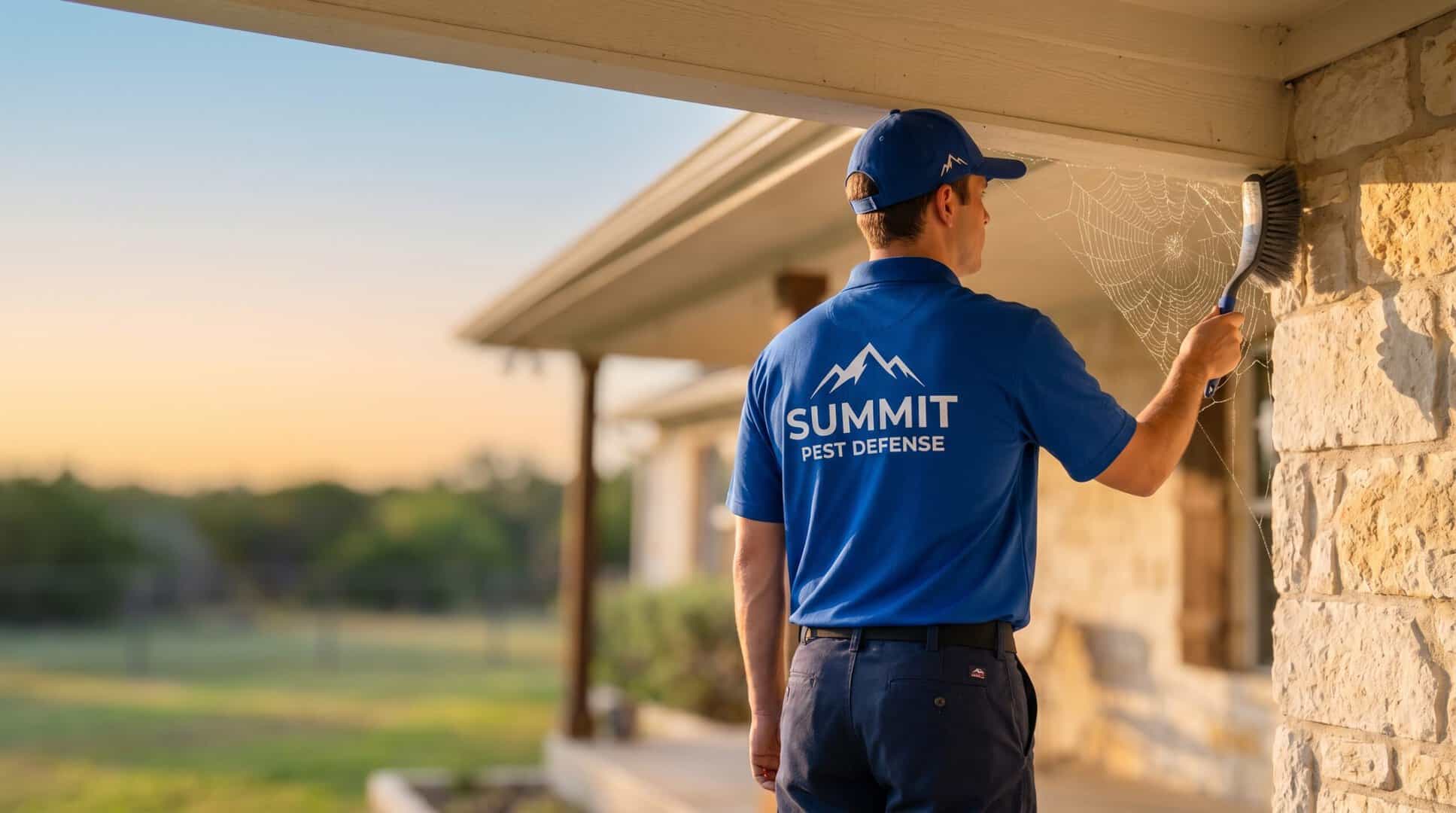
Spider control that targets the whole web, not just the one you saw
Spiders show up in Central Texas homes because the conditions here suit them. Warm seasons, dry stretches, rock foundations, and yards full of insects give spiders steady shelter and a constant food supply. When you see one spider on a wall or a web in a corner, it usually means the property already has the bugs that spiders hunt. Real spider control works on that whole chain, the spiders you can see and the prey that keeps drawing them inside.
We treat spiders the way we treat any pest, with a written price up front and an honest read on what your home actually needs. No scare tactics, no upsell on services you do not need, and no long-term contract to sign. If you have a spider problem, we tell you what we found and how we plan to fix it.
Why spiders move into Hill Country homes
Most spiders are not trying to get into your house. They follow food and moisture. Porch lights pull in moths and gnats at night, and spiders set up webs nearby to catch them. Foundation gaps, garage door gaps, and torn screens give them an easy path indoors. Once inside, they tuck into quiet, undisturbed spots like closets, garages, attics, and the back corners of cabinets.
The dry, rocky ground common across Hays County and Caldwell County also matters. Rock walls, woodpiles, and landscape stone hold heat and harbor insects, and spiders shelter in those same spaces. A home backing up to a greenbelt or open field tends to see more spider activity than one in the middle of a built-out neighborhood.
The house spiders you are most likely to see
The majority of the spiders in a Central Texas home are harmless. Common house spiders, jumping spiders, and cellar spiders eat other insects and generally stay out of your way. They are a nuisance more than a threat, and their webs are usually the first thing people want gone.
- Common house spiders: small, brown or gray, and the source of most of the cobwebs in ceiling corners and window frames.
- Jumping spiders: quick, compact, and often seen on walls or windowsills during the day. They do not build trap webs.
- Cellar spiders: long, thin legs and loose webs in garages, basements, and crawl spaces.
- Wolf spiders: larger and fast on the ground, often wandering in from the yard rather than nesting indoors.
The two spiders worth real caution
Two spiders in our area can deliver a bite that needs medical attention. We treat them differently because they hide in different places and call for closer inspection.
- Black widow: shiny black with a red hourglass underneath. Black widow spiders favor woodpiles, meter boxes, sheds, garages, and the undersides of patio furniture. A black widow web is messy and strong, often low to the ground.
- Brown recluse: tan to light brown with a darker violin shape behind the head. Brown recluse spiders like undisturbed clutter, boxes in the attic, stacked storage, shoes left in the closet. A brown recluse bite can cause a slow-healing wound, so we take any sign of recluse activity seriously.
If you think you have either one, do not crush it by hand and do not reach blindly into stored boxes or dark corners. Point us to where you saw it and we handle the rest.
How we actually treat spiders
A useful spider treatment starts with a walk of the property, inside and out. We look for active webs, egg sacs, and the entry points spiders use, and we note where the prey insects are concentrated. That tells us where treatment will do the most good instead of spraying everywhere and hoping.
Our process covers a few clear steps:
- Knock down and remove webs and egg sacs: clearing existing webs takes away shelter and stops the next generation before it hatches. One egg sac can hold dozens of spiders.
- Treat harborage and entry points: we apply product along the foundation, around windows and doors, under eaves, and in garage corners where spiders travel and rest.
- Use dust where it belongs: in deep voids, attic spaces, and wall gaps, a dust product reaches the dry, tucked-away spots a liquid spray cannot, which is exactly where recluse and widow spiders hide.
- Cut the food supply: because spiders follow insects, knocking back the ants, gnats, and other bugs on the property removes the reason spiders stay.
We match the product and method to the spider and the spot. A garage with widow activity gets handled differently than an attic with recluse signs or a porch with seasonal cobwebs. That targeting is what separates a real fix from a quick spray that brings the spiders right back.
Why this approach holds up
Spiders are tied to the rest of the bug activity around your home, so treating them in isolation rarely lasts. By clearing webs, treating the harborage spots, and reducing the prey insects at the same time, we break the cycle instead of just lowering the count for a week. If spiders come back between scheduled visits, we re-treat at no extra charge. That guarantee is part of every plan we set up, and it keeps the focus on results rather than repeat trips.
Spiders are also a strong sign of a broader pest picture. A home with heavy spider activity often has the ants, roaches, or other insects feeding them, which is why our general residential pest control service pairs naturally with spider work. Knocking out the food source does as much for long-term spider control as treating the spiders themselves.
Prevention and sealing after the treatment
Treatment clears the current problem. Sealing and yard work keep it from coming back. We point out the gaps and conditions inviting spiders in, and many of these are simple fixes a homeowner can keep up between visits.
- Seal gaps around foundation, door sweeps, garage doors, and where utility lines enter the home.
- Repair torn window and door screens that let wandering spiders inside.
- Move woodpiles, stone, and stored items away from exterior walls so spiders lose their close-in shelter.
- Clear clutter in garages, closets, and attics, the quiet spaces where recluse and widow spiders settle.
- Switch porch and entry lighting to bulbs that draw fewer night insects, which cuts the food that pulls spiders to your doorstep.
Spiders in storage areas often run alongside rodents using the same gaps and clutter, so if you are seeing both, our rodent control service addresses those shared entry points at the same time.
The Central Texas spider season
Spider activity in our area peaks as the weather warms and insect populations climb, with another surge in fall when spiders look for shelter ahead of cooler nights. Homes in Kyle, Buda, San Marcos, and the surrounding Hill Country see widow spiders move into garages and meter boxes through the warm months, and recluse sightings tend to rise as people move stored items in late season.
Because the dry Texas Hill Country gives spiders plenty of rock and wood to shelter in, a single treatment rarely covers a full year on its own. Regular service through the active seasons keeps the count down and catches the dangerous spiders before they settle in. Scorpions share many of the same hiding spots and entry habits, so households dealing with both can fold our scorpion control into the same visit and treat the whole problem in one pass. If you call before noon, we can usually get to you the same day.