
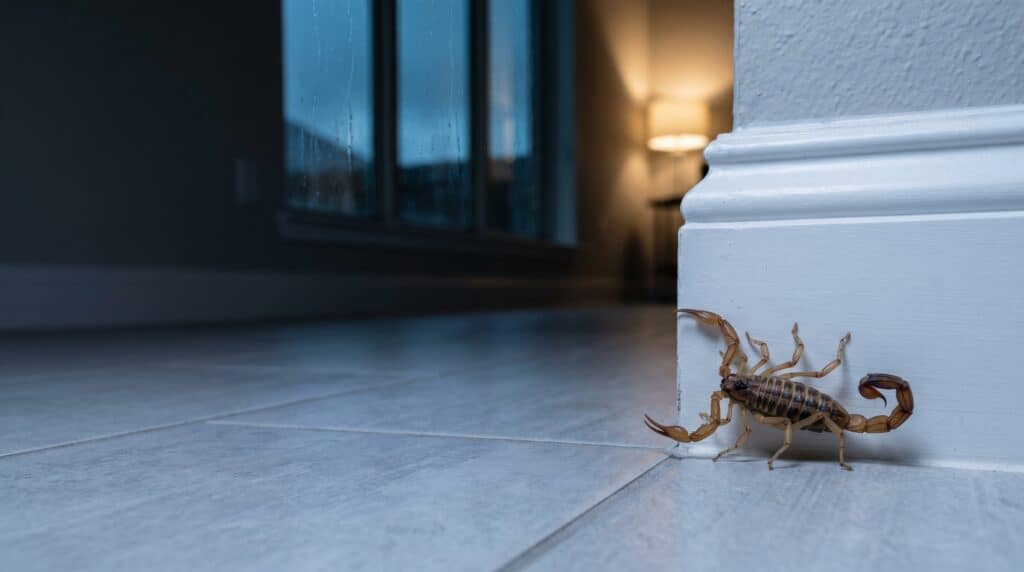
You hear the storm roll through, and a day or two later there’s a scorpion on the bathroom tile. It’s not a coincidence. Across the Texas Hill Country, a hard rain and a stretch of summer heat push striped bark scorpions indoors, and they’re chasing two things you can actually do something about: moisture and the bugs they eat. Handle those, seal the gaps, and you take away their reason to come inside.
The short version: Striped bark scorpions make up about 95% of Texas scorpion encounters (Texas A&M AgriLife). After a hard Hill Country rain they move indoors looking for moisture and prey. They’re most active April through October, peaking June to August. No Texas scorpion is considered lethal, but a sting hurts, and kids, older adults, and anyone immunocompromised should see a doctor. Control the bugs and seal the gaps, don’t just chase the scorpion.
Why a hard rain pushes scorpions indoors
Scorpions don’t want to be in your house. They’re built for the rocky, brushy ground outside. But a heavy rain floods their harborage under rocks and mulch, and the heat that follows dries everything out fast, so they go looking for stable conditions. Your home offers cool, humid spots and a buffet of insects that came in for the same reasons. When the bugs move in, the scorpions follow.
That’s the whole pattern in one sentence: after a storm, scorpions follow moisture and prey through whatever gaps your house leaves open. Knowing that changes how you fight them.
Meet the striped bark scorpion, the one you’ll actually see
Texas has several scorpion species, but in the Hill Country you’re almost always dealing with the striped bark scorpion. It accounts for about 95% of human scorpion encounters in Texas (Texas A&M AgriLife). You can spot it by the two dark stripes down its back and a tan, yellowish body. It runs 1 to 3 inches long and lives about four years.
It’s a climber, which is the part that surprises people. Unlike the chunky desert scorpions you picture, the striped bark scorpion will scale a wall, get into an attic, and turn up on a ceiling or in a second-floor room. That climbing habit is why sealing the ground floor alone often isn’t enough.
How bad is a scorpion sting in Texas?
Here’s the straight answer, without the fear-selling. A striped bark scorpion sting feels like a bad bee sting: sharp pain, numbness, and some swelling that usually settles down within 24 to 48 hours (Texas A&M AgriLife). No scorpion in Texas is considered lethal to people.
The honest caveat is who got stung. Children under 10, adults over 65, and anyone with a compromised immune system can have more severe reactions and should get medical care after a sting. The same goes for anyone with trouble breathing or other allergy-type symptoms. We’re a pest control company, not a doctor’s office, so for the sting itself, when in doubt, call a medical professional.
Where scorpions get in and hide in Hill Country homes
Hill Country homes sit on rocky, limestone ground that gives scorpions plenty of harborage right up against the foundation. From there, the way in is usually a short list of gaps:
- Weep holes in brick veneer, the small openings near the base of the wall
- Gaps around plumbing and utility penetrations through the slab
- Garage door thresholds and gaps under exterior doors
- The attic, especially where the roofline meets the walls
- Cool, humid living spaces inside: under sinks, in bathrooms, in closets, and in stored shoes and clothing
Because they climb, scorpions don’t stay near the floor. Shake out shoes, gloves, and anything left on the floor before you put it on, and keep beds and furniture a little away from the walls.
Same-night steps to take when you find one inside
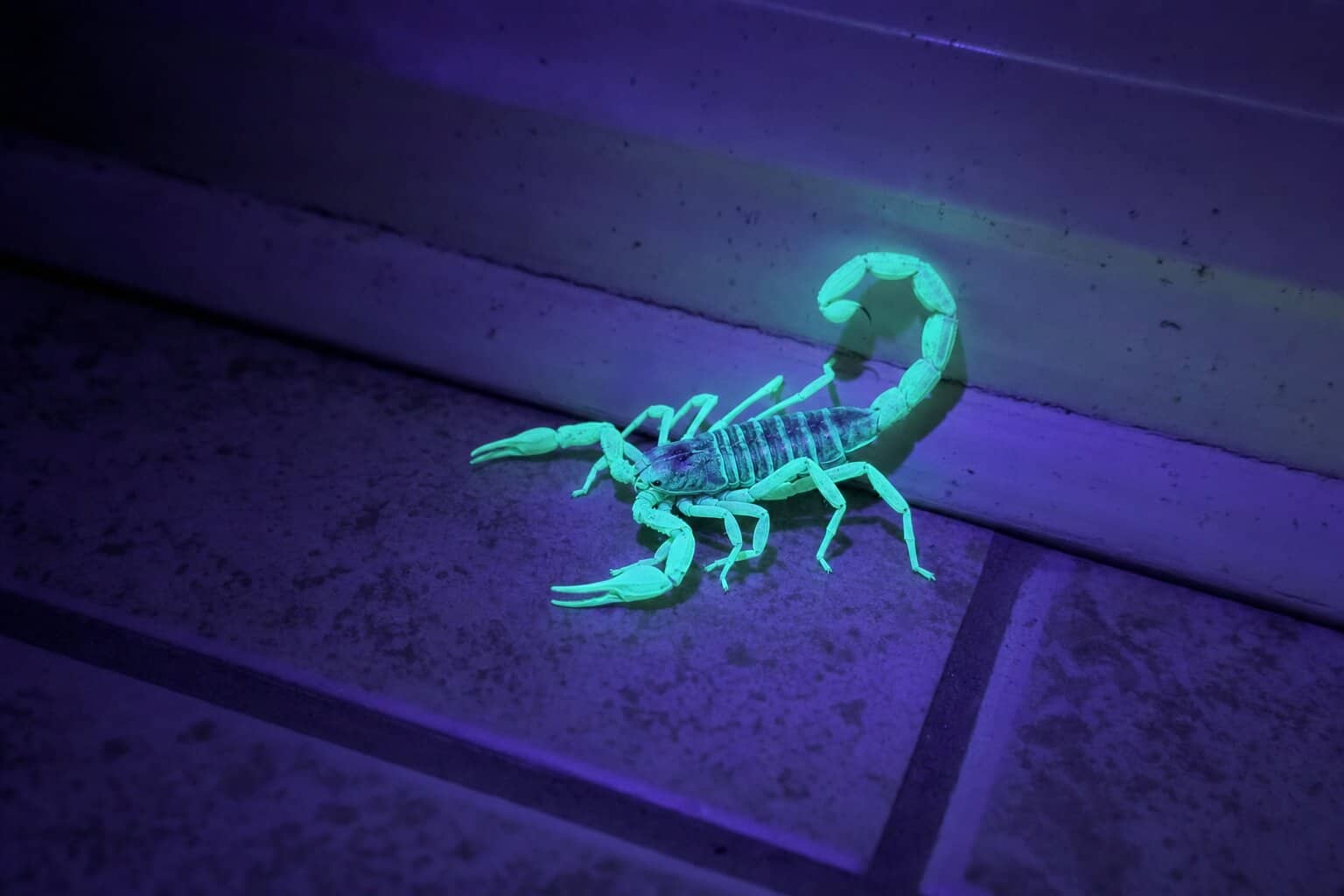
Found one on the wall at 11pm? A few things help right now. Scorpions glow a bright blue-green under ultraviolet light, so a cheap UV blacklight turns a frustrating hunt into an easy one. Walk the baseboards, closets, and corners after dark and you’ll find them fast.
- Run a UV blacklight sweep at night to spot and remove the ones inside
- Set sticky traps along baseboards, in closets, and behind furniture to catch the wanderers and show you where they’re traveling
- Knock down the insects they’re hunting, since fewer bugs means fewer scorpions
- Reduce moisture: fix drips, run a bathroom fan, and clear damp clutter
- Declutter the garage and closets so there’s less to hide under
Sealing scorpions out: the exclusion that actually works
Spraying a scorpion you can see is satisfying, but it does nothing about the next one. The work that actually moves the needle is exclusion plus controlling their food. Good scorpion control means screening the weep holes, adding door sweeps, caulking the slab and utility penetrations, and treating the exterior band where scorpions cross from the rocks into the house. Pair that with general pest control to thin out the insects they eat, and the scorpions lose both the doorway and the dinner.
These prevention strategies beat one-off spraying every time, because you’re changing the conditions instead of playing whack-a-mole. It’s slower and less dramatic, and it’s the part that keeps them out for good.
Wimberley, Dripping Springs, and the rest of the Hill Country
Scorpion pressure tracks the terrain, and the rockier and brushier your lot, the more harborage you’ve got. The limestone ground around Wimberley and Dripping Springs, and the wooded, hilly neighborhoods near San Marcos, Buda, and Kyle, give scorpions far more cover than a flat clay lot in town. Newer subdivisions carved into that terrain see it too, because construction disturbs the ground and the scorpions get pushed toward the nearest shelter, which is often the new house.
It’s one reason the Texas Hill Country has a reputation for scorpions that the flatlands don’t. The bugs aren’t meaner here; the habitat is just better.
Are scorpions a danger to your pets?
It’s a fair worry, especially with a curious dog that noses into rock piles. A striped bark scorpion sting hurts a pet about as much as it hurts you, sharp pain and some swelling, and for most healthy dogs and cats it isn’t dangerous. The trouble is that pets tend to find scorpions the hard way, with a paw or a nose, and very small pets can react more strongly. If your pet gets stung and you see heavy swelling, drooling, trouble breathing, or real distress, call your vet, the same way you’d call a doctor for a person with a bad reaction. The prevention is the same work that protects the family: keep pets away from rock walls and woodpiles at dusk, run a UV light check where they play, and seal and treat the perimeter so there are fewer scorpions around in the first place.
When to call a pro, and what we do differently
If you’re finding scorpions regularly, or you’ve got young kids and the stakes feel higher, that’s the point to bring in pest control. A recurring exterior program keeps the perimeter treated and the entry points sealed through peak scorpion season, so you’re not relying on a blacklight every night.
We diagnose first and treat second. We walk the property, find the gaps and the harborage, and tell you what’s driving the problem before we treat anything. We’re a local, family-owned team, so you get a straight answer and the same crew each visit. No contracts, one written price up front, and free retreatments if activity comes back between visits. Book a scorpion inspection or call us before noon and we’ll usually be out the same day.