
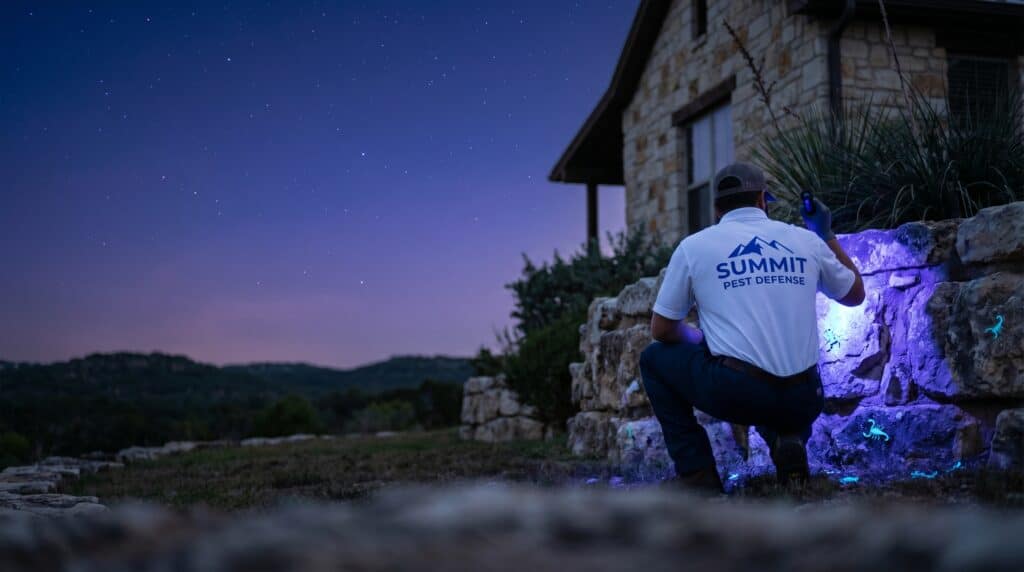
Pretty much every yard in the Hill Country has the same look: limestone borders, dry-stack rock walls, a bed of decorative gravel where grass won’t grow. It handles our heat and rocky ground well. It also happens to be close to ideal housing for scorpions. If you keep finding them in the garage or on a wall inside, the rock around your foundation is a big part of why.
The short version
- Scorpions hide in the cool, tight gaps in limestone rock beds, dry-stack walls, and mulch right up against the house.
- The striped bark scorpion is the one you’ll almost always see here, and unlike most, it climbs walls and gets indoors.
- Rock and mulch piled against the foundation give scorpions both cover and a bridge inside through small gaps.
- You can make a yard far less scorpion-friendly, and a perimeter treatment plus sealing handles the rest.
Why limestone and rock landscaping draws scorpions
Scorpions want three things: a tight, humid hiding spot during the day, cool ground to escape the heat, and prey to eat. Hill Country rock landscaping gives them all three. The gaps between stacked stones and the spaces under a gravel bed hold moisture and stay cool, which is exactly where a scorpion wants to wait out a hot afternoon.
Dry-stack walls are the worst offender. Every joint is a doorway, and the wall runs deep enough to shelter a whole population. Decorative rock beds and rock mulch laid right against the foundation do the same thing on a smaller scale. Wood mulch holds moisture and the insects scorpions hunt, so it pulls them in too.
The other draw is dinner. Rock and mulch beds are full of crickets, roaches, spiders, and other bugs, and those are scorpion prey. Where the prey gathers, the predators follow. Cut the bugs and you cut the reason scorpions camp by your wall in the first place.
The striped bark scorpion, the one you’ll actually see
Texas has a lot of scorpion species, but in our area you’ll almost always be looking at the striped bark scorpion. It’s the most common and widespread scorpion in Texas, according to Texas A&M AgriLife Extension. It’s tan with two darker stripes down its back, usually about two to three inches long.
Two things make this species a problem indoors. First, it climbs. Most scorpions stay on the ground, but the bark scorpion will go up a rock wall, up the side of your house, and into a weep hole or a gap in the trim. Second, it’s a hitchhiker that ends up on walls, on ceilings, and in shoes left in the garage. Shine a UV flashlight in the yard at night and they glow bright blue-green, which is the easiest way to see how many you really have.
A sting hurts a lot, on the order of a bad wasp sting, but for most healthy people it isn’t dangerous. If someone has trouble breathing or a severe reaction after a sting, that’s a call to a doctor, not a pest tech. We treat the bug; we don’t give medical advice.
How scorpions get from the rock bed into the house
The trip from your wall to your living room is short. A bark scorpion climbs the foundation, finds a weep hole, a gap under a door, a crack where the slab meets the brick, or a spot where a pipe enters the wall, and walks in. Once inside, it heads for the humid rooms, so bathrooms, laundry rooms, and garages are the usual finds.
The closer your rock and mulch sit to the house, the shorter that trip. A rock bed touching the foundation is basically a launch pad. Pull that cover back and seal the openings and you take away both the staging area and the door.
How to make your yard less scorpion-friendly
You don’t have to rip out your landscaping. A few changes make a real difference.
- Keep a clear band against the foundation. Pull rock, gravel, and mulch back about a foot from the wall so there’s a dry, open strip. Scorpions hate crossing open ground.
- Seal the entry points. Caulk gaps where pipes and wires enter, add door sweeps, and screen your weep holes with weep-hole covers. This is the single highest-value fix.
- Knock down the prey. A perimeter treatment that cuts crickets, roaches, and spiders removes the food that keeps scorpions nearby.
- Declutter the yard. Stacked firewood, landscape timbers, flat stones, and clutter against the house are all daytime hideouts. Store firewood off the ground and away from the wall.
- Trim it back. Tree limbs and shrubs touching the roof or walls give climbers another route in. Keep a gap.
How we handle scorpions in the Hill Country
Scorpions are tougher than your average bug. They can go months without eating and they shrug off the light over-the-counter sprays, so a one-time fog doesn’t do much. Real scorpion control is about the perimeter and the gaps, not a cloud of spray.
We walk the property, usually with a UV light at dusk, to find where they’re harboring. We treat the foundation, the rock walls, the mulch beds, and the entry points, and we knock down the prey insects at the same time so the food source dries up. Then we come back on a schedule, because scorpions move in from the surrounding rock and brush all season. No contract, one price up front, and if they show back up between visits, so do we.
Where scorpions hide indoors, and how to find them
Once a bark scorpion is in the house, it goes where it’s dark, tight, and a little humid. Knowing the usual spots helps you check before you reach and tells you where treatment needs to focus.
- Bathrooms and laundry rooms. They’re drawn to moisture, so they turn up in tubs, sinks, and behind washers. A scorpion in the tub can’t climb the slick sides, which is why people find them there in the morning.
- Closets, shoes, and stored clothing. Dark and undisturbed is exactly their style. Shake out shoes left in a closet or the garage before you put them on.
- Under and behind furniture. Beds, dressers, and baseboards give them edges to hug. They like to press their bodies against a surface, so they hang along cracks and corners.
- Up high. Because the bark scorpion climbs, it shows up on walls and ceilings, not just the floor. Check above you, not only below.
The single best way to know what you’re dealing with is a night hunt with a UV flashlight. Scorpions glow blue-green under blacklight, so after dark you can walk the rooms, the garage, and the foundation outside and actually see them light up. Do it a couple of nights in a row and you’ll learn where they’re coming in and how many you really have, which beats guessing from the one you found in the sink. It’s also exactly what we do on an inspection, because you can’t treat what you can’t find.
Finding scorpions on your walls and tired of it? Call Summit Pest Defense at (512) 757-7533 for same-day service when you call before noon, or get a free, no-obligation quote. We’re a family-owned, three-generation team handling scorpion control across Kyle, Buda, San Marcos, and the surrounding Hill Country, and we answer to our last name.
Storm season changes scorpion behavior fast. See how a hard rain pushes striped bark scorpions indoors.