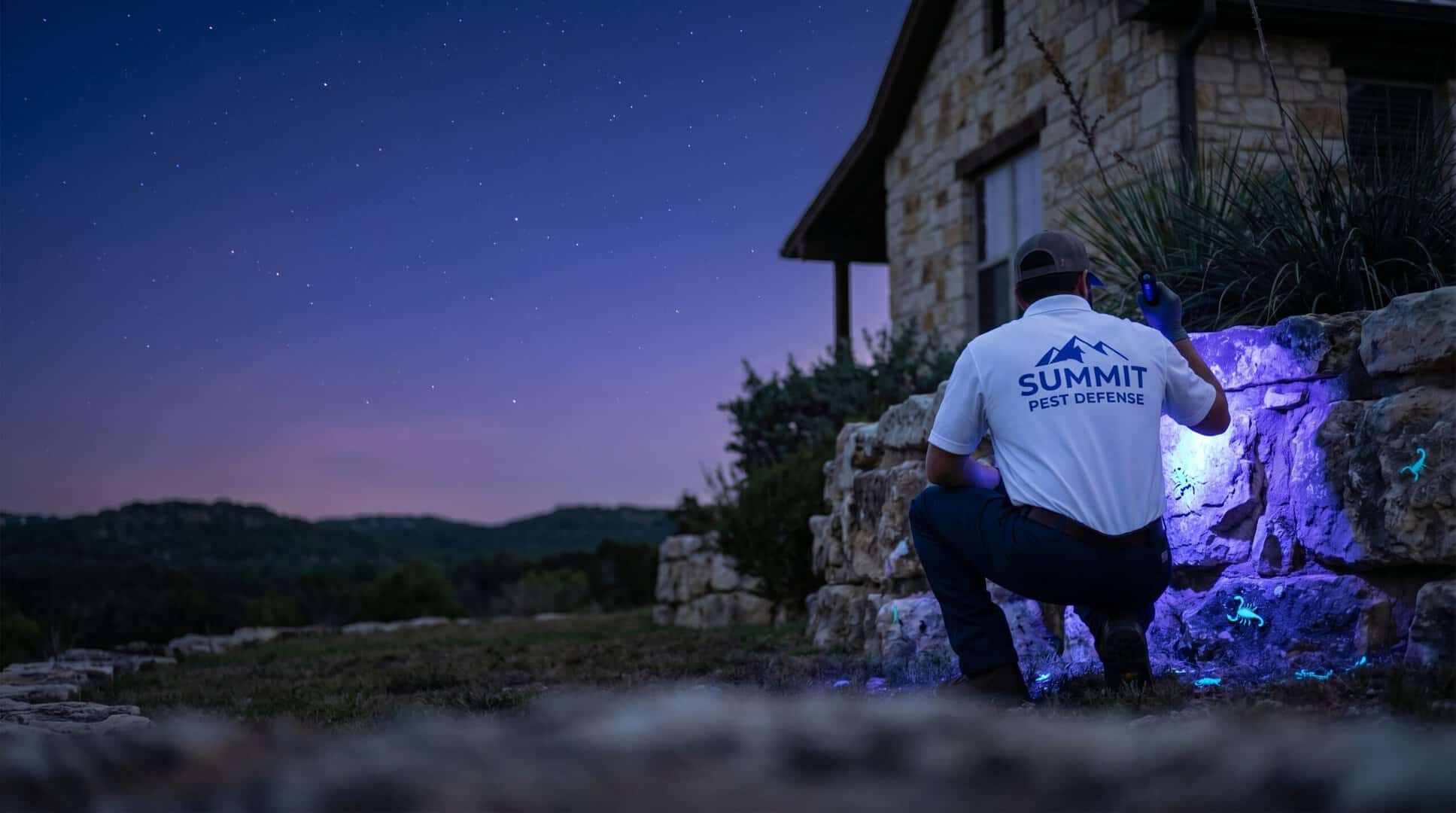
Scorpion control for Texas Hill Country homes and businesses
Scorpions are one of the more unsettling pests we deal with across the Hill Country, partly because they show up where you least expect them: in a shower, inside a shoe, or along a baseboard at night. The good news is that scorpions are manageable. With the right scorpion control plan, a focused treatment, and some sealing work, you can keep them out of your home and away from the spaces your family and pets use.
We have treated scorpions here for three generations, so we know how they behave, where they hide, and what it takes to reduce their numbers. Below is a straight explanation of the pest, the signs, and how we treat it.
What scorpions are and why they show up here
Scorpions are arachnids, related to spiders, with eight legs, a pair of pincers, and a curved tail that ends in a stinger. The most common scorpion in our region is the striped bark scorpion, a tan, slender species that grows to roughly two to three inches. Unlike a desert scorpion built for open sand, the bark scorpion is a climber. It moves up walls, across ceilings, and into attics, which is why people so often find one well above floor level.
The limestone, brushy terrain, and dry summers across Hays County and Caldwell County create good scorpion habitat. Rock walls, wood piles, leaf litter, and stacked landscape stone all give them daytime shelter. When the weather turns very hot or very dry, scorpions push toward the cooler, moister conditions inside a home. That is when most calls come in. They are hunting the same insects you want gone, so a property with plenty of crickets, roaches, and spiders is a property that feeds scorpions.
Signs of a scorpion problem
Scorpions are nocturnal and secretive, so you rarely see the full picture during the day. A few clues that point to a scorpion infestation building on your property:
- Live scorpions found indoors at night, often near plumbing, in bathrooms, or in the garage
- Scorpions glowing a pale blue green under a UV flashlight, which is the fastest way to spot them after dark
- Heavy insect activity, since a large prey supply keeps scorpions well fed and breeding
- Gaps around door sweeps, weep holes, foundation cracks, and pipe penetrations that give them easy entry
- Repeated sightings in the same room, which usually means a harborage point is close by
Correct scorpion identification matters. People sometimes confuse them with other pests in low light, and the treatment plan changes depending on what we actually find. If you can safely photograph one, that helps us confirm the species before we arrive.
Are scorpion stings dangerous?
For most healthy adults, a sting from the striped bark scorpion is painful but not a medical emergency. It feels something like a wasp sting, with localized pain, swelling, and numbness that fades over a day or so. Scorpion venom from this species is mild compared with the more dangerous scorpions found in parts of Arizona and the broader desert Southwest. That said, reactions vary. Young children, older adults, and anyone with an allergy can react more strongly, so a sting that causes trouble breathing, severe swelling, or other body-wide symptoms warrants a call to a doctor. The simplest way to avoid scorpion stings is to keep them out of the spaces where people walk barefoot and reach into dark corners.
How we treat scorpions
Killing scorpions one at a time does nothing for the problem, because the ones you see are a fraction of what is on the property. Our approach works on the whole habitat, not just the individual scorpion. When we come out, we start with an inspection of the home and yard, inside and out, so the plan fits your specific situation.
From there, treatment generally includes:
- Targeted exterior barrier: we apply a residual product around the foundation, weep holes, window frames, door thresholds, and other entry points where scorpions cross into the structure.
- Harborage treatment: we treat the places they shelter during the day, including rock borders, wood piles, fence lines, and dense ground cover near the house.
- Knocking down the food supply: because scorpions follow their prey, we reduce the crickets, roaches, spiders, and other insects they eat. Cut the buffet and the scorpions have less reason to stay.
- Interior spot work: when scorpions are already getting inside, we treat cracks, crevices, attic access points, and plumbing voids where they travel.
We use professional-grade materials applied at labeled rates, placed where scorpions actually go rather than broadcast everywhere. A store-bought insecticide or a bag of diatomaceous earth dusted along a wall might catch a few, but it will not address the harborage and prey pressure driving the problem. This is why effective scorpion control is steady, repeated service rather than a one-time spray.
Why this approach works
Scorpions are tough. Their hard outer shell resists casual contact with many products, and they can go a long time without food or water. That durability is exactly why the habitat-focused method matters. By treating the barrier, the harborage, and the food source together, we make the property far less livable for them. Over a few service visits, the numbers drop, the indoor sightings taper off, and the property stops acting like a magnet for the next generation.
Because scorpions and the insects they hunt overlap so heavily, this work pairs naturally with broader residential pest control. When your home is already on a regular schedule for the common pests of this region, the scorpion pressure tends to stay low without a separate emergency call.
Sealing and prevention
Treatment reduces the population. Sealing keeps the survivors outside. We point out the entry points we find during the inspection, and there are several things homeowners can do to make a real difference:
- Install or replace door sweeps so there is no gap under exterior doors, since a bark scorpion fits through a surprisingly thin opening
- Seal cracks in the foundation and caulk around pipe and utility penetrations
- Screen weep holes with stainless mesh, a common scorpion entry path in brick homes
- Move wood piles, stone, and debris away from the foundation and off the ground where possible
- Trim back shrubs and ground cover that touch the house and create shaded, humid harborage
- Reduce moisture from leaky spigots and clogged gutters, which draws both scorpions and their prey
Because the bark scorpion is a climber, do not forget the upper parts of the home, including attic vents, soffit gaps, and second-story window frames.
The local Central Texas angle
Scorpion activity here follows the seasons. The warm stretch from late spring through early fall is peak season, when the heat pushes scorpions toward shelter and breeding ramps up. A wet spell followed by a hot dry one tends to drive a wave of indoor sightings. Newer neighborhoods built on cleared limestone land often see more scorpions in their first years as the displaced population settles into the new structures.
We live and work in the same towns we serve, from Kyle and Buda to San Marcos and Wimberley, so the timing of our service plans matches the local conditions rather than a generic national calendar. Homes and businesses both get the same honest approach: one written price up front, no long-term contract, and a re-treat between visits if scorpions come back. Scorpions also tend to travel alongside spiders, since both are arachnids drawn to the same dark, sheltered spaces, so combining this service with spider control often gives a property the cleanest result. If you are weighing your options across pests, our full range of pest control services is built around the conditions of this region, not a one-size template.