
If your place backs up to a greenbelt, a creek, or open brush, you’ve got deer moving through, and where the deer go, lone star ticks follow. You don’t have to hike to pick one up. They wait in the tall grass and brushy edges of your own yard, and the lone star tick in particular is an aggressive biter that will come looking for a host. Out here it’s the tick you’re most likely to run into.
The short version
- Deer are the main host for lone star ticks, so yards near brush, greenbelts, and creeks get the most.
- The lone star tick is the most common human-biting tick in our region, and it actively hunts for a host instead of just waiting.
- A lone star tick bite can trigger alpha-gal syndrome, a red meat allergy. Cutting tick habitat in your yard lowers your family’s exposure risk.
- Mowing, clearing brush, and a perimeter yard treatment along the edges are what actually reduce the ticks around the house.
Why deer and brush put ticks in your yard
Lone star ticks need hosts and cover, and the Hill Country hands them both. Deer are the primary host that carries adult lone star ticks and drops engorged females to lay eggs, so any property on a deer route is restocking its tick population all season. Other wildlife, raccoons, opossums, foxes, and ground birds, move the younger ticks around too.
The cover is the other half. Ticks dry out in open sun, so they hang in the humid, shaded spots: tall grass, leaf litter, brush piles, the un-mowed edge where your lawn meets the trees. They climb a blade of grass, stretch out their front legs, and wait to grab onto whatever brushes past. That behavior is called questing, and the lone star tick is more willing than most to crawl toward a host it senses. The brushy border of your lot is the front line.
Meet the lone star tick
The lone star tick is easy to recognize on the adult female: a single white or silvery dot in the center of her back. It is the most frequently encountered human-biting tick across the southeastern and south-central U.S., according to the CDC, and Central Texas sits squarely in its range. All three life stages, larva, nymph, and adult, will bite people, and the tiny nymphs are easy to miss until they’re attached.
They’re also prolific. A single engorged female can lay thousands of eggs, which is how one deer wandering through can seed a yard with a whole new generation.
The alpha-gal connection
Here’s the one that catches people off guard. A bite from a lone star tick can trigger alpha-gal syndrome, an allergy to red meat (beef, pork, lamb) that can develop after the bite. It’s increasingly recognized in areas where lone star ticks are common. We want to be clear about our lane here: we’re a pest control company, not a medical provider, so we can’t and won’t claim to treat, cure, or prevent alpha-gal syndrome or any illness. If you think you’ve developed it, that’s a conversation with your doctor.
What we can do is straightforward and worthwhile: the fewer lone star ticks living and questing in your yard, the fewer bites your household is exposed to, and that lowers your risk of exposure to anything a tick bite can cause. Reducing the ticks is the part you actually control.
Other tick-borne illness, and the Lyme mix-up
Lone star ticks can also carry pathogens that cause illnesses like ehrlichiosis, so a bite is worth watching regardless of the alpha-gal angle. Watch the bite site, and see a doctor if you develop a fever, rash, or feel unwell after a known tick bite.
One common mix-up: classic Lyme disease is mainly spread by the blacklegged (deer) tick, not the lone star tick, and Lyme is uncommon in Central Texas compared to the Northeast. The lone star tick is its own problem with its own risks. Either way, the practical move is the same, keep ticks off your property and off your body.
How to make your yard less tick-friendly
- Mow and keep it short. Ticks need tall grass and humidity. A regularly mowed lawn is hostile ground for them.
- Clear the edges. Cut back brush, pull leaf litter, and remove brush piles along the property line where the lawn meets the trees. That border is where the ticks concentrate.
- Make a dry buffer. A strip of gravel or wood chips between the lawn and the woods is hard for ticks to cross and keeps them out of the play area.
- Discourage deer and rodents. Skip the plants deer browse near the house, and keep bird seed and brush from drawing rodents that ferry young ticks.
- Treat your pets. Dogs and cats carry ticks straight indoors. Keep them on a vet-recommended tick preventive year-round.
- Treat the yard. A perimeter treatment focused on the brushy edges and shaded harborage knocks down the questing ticks where they actually live.
How we handle ticks in the Hill Country
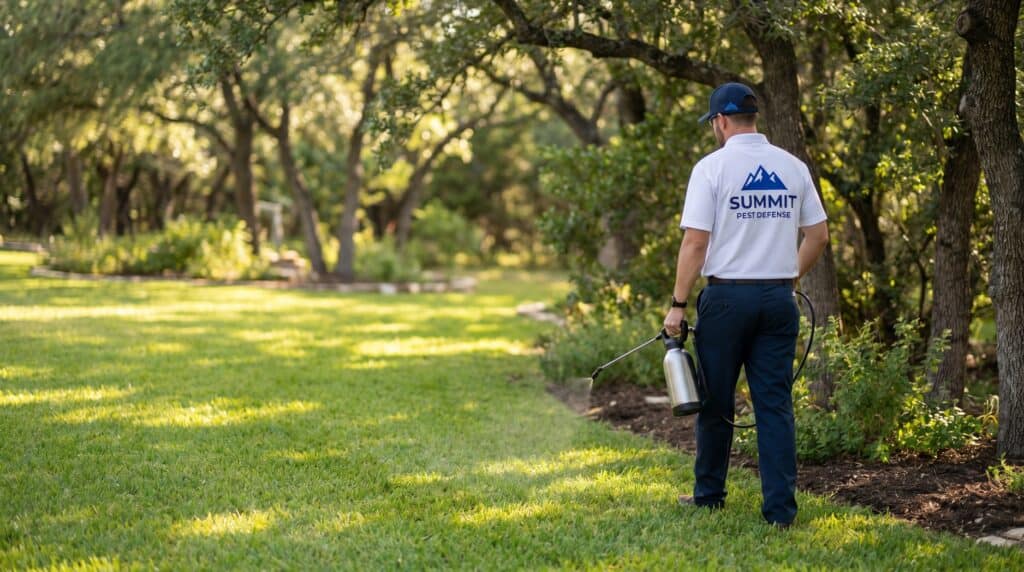
We don’t fog the whole lawn and call it done. We target the edges, the shade, the leaf litter, and the brush line, the humid harborage where ticks wait, plus the routes pets and wildlife use to bring them in. We time treatments through the warm months when ticks are active and pair yard work with keeping fleas in check, since the two travel together. Effective flea and tick control is about hitting the harborage on a schedule, because deer and wildlife keep restocking your property from the brush all season.
No contract, one price up front, and if the activity comes back between visits, so do we.
Checking for ticks, and removing one the right way
Yard treatment cuts the numbers, but if you spend time in the brush you’ll still want a routine. Lone star tick nymphs are tiny, so a quick check after time outside catches them before they attach for long.
- Check within a couple of hours of coming in. Scan the warm, tight spots ticks head for: behind the knees, the groin, the waistband, armpits, the scalp and hairline, and behind the ears. On kids, check the head and neck carefully.
- Don’t forget the dog. Run your hands over pets after they’ve been outside, especially the ears, between the toes, and under the collar. Pets carry ticks straight indoors and into beds.
- Shower and change. A shower soon after being outside helps wash off unattached ticks, and tossing your clothes in a hot dryer for ten minutes kills any hitchhikers.
If you find one attached, remove it the simple way: fine-tipped tweezers, grab as close to the skin as you can, and pull straight up with steady pressure. Don’t twist, and skip the old tricks, a lit match, nail polish, petroleum jelly, all of which can make the tick worse or leave mouthparts behind. Clean the bite with soap and water afterward. It’s worth saving the tick in a bag or a photo and noting the date, so if you feel unwell later your doctor knows what bit you and when.
To be clear about our role: we’re not giving medical advice, and any fever, spreading rash, or feeling sick after a bite is a reason to call your doctor, not us. What we can do is cut how many ticks are waiting in your yard in the first place, so there are fewer bites to check for.
Worried about ticks on your acreage? Call Summit Pest Defense at (512) 757-7533 for same-day service when you call before noon, or get a free, no-obligation quote. We’re a family-owned, three-generation team handling flea and tick control across Kyle, Buda, San Marcos, and the surrounding Hill Country, and we answer to our last name.